



Milk vs. Soy vs. Water Kefir: Which Fermentation Profile Fits Your Taste?
If you are choosing between milk kefir, soy kefir, and water kefir, start with the drink you actually want in your glass. Do you want something creamy for breakfast, a non-dairy drink with more body than a sparkling beverage, or a light afternoon refreshment for hot weather?
The practical takeaway is simple: choose milk kefir when you want creamy dairy richness and a yogurt-like drinking experience. Choose soy kefir when you want a plant-based option with more body than water kefir. Choose water kefir when you want something lighter, refreshing, and often gently fizzy. None of the three is the universal “best.” They are different fermentation profiles for different sensory jobs.
Results still vary. Starter condition, temperature, sugar availability, the base formula, and fermentation time can change sourness, texture, and carbonation. Think of this guide as a practical menu: creaminess, plant-based body, or refreshing fizz.
The comparison at a glance
| Base | Texture/body | Flavor direction | Fizz tendency | Dietary fit | Fermentation tendency | Best use case |
|---|---|---|---|---|---|---|
| Milk kefir | Creamy, opaque, fuller dairy body | Tangy, milky, yogurt-like | May have light carbonation, but fizz is not the main point | Contains dairy; may still contain lactose | Often develops acidity and body clearly, depending on milk and starter | Creamy breakfast drink, smoothie base, drinkable-yogurt style |
| Soy kefir | Plant-based body; usually fuller than water kefir | Mild soy or bean note, gently tangy | Usually less about sparkle than water kefir | Can suit dairy avoidance if starter and handling are vegan-suitable | Texture and sourness depend strongly on soy milk formula, sugar, starter, and time | Non-dairy drink that still feels substantial |
| Water kefir | Light, translucent, thinner body | Refreshing acidity; often fruit, floral, or lightly sweet-sour | Often sparkling-style, but carbonation varies | Water-based; often useful for dairy-free preferences if ingredients fit | Sweetness reduction, aroma, acidity, and sometimes bubbles are more noticeable than thickness | Hot-weather refreshment or a fermented alternative to sweet fizzy drinks |
This table describes tendencies, not guarantees. Kefir is alive enough to be variable, and the base gives it a direction rather than a fixed script.
Milk kefir: when you want creaminess, tang, and a dairy body
Milk kefir is the choice when you want a creamy, tangy drink with a familiar dairy aroma. It sits closest to a drinkable yogurt experience: opaque, rounded, slightly sour, and substantial enough to pair with breakfast or fruit.
Milk naturally contributes proteins, milk solids, minerals, and lactose. Those components help create a richer mouthfeel than water-based kefir. If you like the sensation of a smoothie, lassi, or plain yogurt drink, milk kefir is usually the most intuitive starting point.
There is one important dietary caveat: milk kefir contains dairy and may still contain lactose. Fermentation may reduce lactose depending on time, starter activity, and process, but it should not be treated as lactose-free by default. If you are lactose-sensitive or avoiding dairy strictly, use caution and choose a base that matches your needs.
Choose milk kefir if you:
- want a creamy breakfast drink rather than a soda-like refreshment;
- enjoy dairy tang and a yogurt-like finish;
- want a base that blends easily with fruit;
- prefer body and softness over sparkle;
- do not need a dairy-free or vegan option.
Milk kefir can show some carbonation, especially with certain fermentation conditions or flavoring approaches, but bubbles are not the main measure of success. Aroma, acidity, texture, and balanced sourness tell you more than fizz alone.
Soy kefir: when you want a non-dairy option with more body
Soy kefir is the practical middle path for many readers: non-dairy like water kefir, but usually more substantial in the mouth. A good soy kefir can feel smoother and fuller than many other plant-based bases, while still carrying the familiar soy flavor that some people enjoy and others may want to soften with fruit or gentle flavoring.
The evidence here needs careful wording. A 2024 comparative study of dairy and soy yogurt-style fermented products found similar stability-related markers such as pH, lactic acid, water activity, and moisture content between dairy and soy products. The same research context also supports the idea that soy milk can provide relatively higher viscosity and gel strength among plant-based fermented bases. That does not prove every soy kefir batch will behave like dairy kefir, but it does help explain why soy is a plausible option when you want a thicker plant-based fermented drink. See the study in this 2024 dairy and soy fermented product comparison.
Soy fermentation depends heavily on the exact soy milk. Some soy milks contain only soybeans and water; others include sugar, oils, stabilizers, minerals, or flavorings. Those choices can affect texture, sourness, separation, and how active the fermentation seems. Starter condition, temperature, and time also matter.
Choose soy kefir if you:
- avoid dairy but want more body than water kefir;
- like soy milk or plant-protein flavors;
- want a drink that feels more substantial than a sparkling refreshment;
- prefer a plant-based option for everyday use;
- can confirm the starter and handling process fit your vegan or dairy-free needs, if those are strict requirements.
Soy kefir should not be described as nutritionally identical to milk kefir. The useful comparison is practical: mouthfeel, flavor, dietary fit, and how the base behaves during fermentation.
Water kefir: when you want light, refreshing, and gently fizzy
Water kefir is not a diluted version of milk kefir. It is its own format: water-based, lighter in body, and often enjoyed for refreshing acidity and a sparkling-style mouthfeel. It can lean fruity, floral, citrusy, herbal, or lightly sweet-sour depending on how it is prepared and flavored.
This makes water kefir especially useful when you want something cool and bright rather than creamy. In Taiwan’s warm weather, it can make more sense as an afternoon drink than a heavy dairy beverage. It can also be a practical alternative when you want a fermented drink but are avoiding dairy.
Fizz is part of water kefir’s appeal, but it is not the only sign of fermentation. A water kefir that tastes less sweet, smells pleasantly fermented, has balanced acidity, and feels lively may be doing exactly what you want even if it is not aggressively bubbly. On the other hand, strong carbonation alone does not prove quality or safety.
Choose water kefir if you:
- want a light drink rather than a creamy one;
- prefer fruit, floral, citrus, or herbal flavor directions;
- avoid dairy or want a water-based option;
- want a sparkling-style fermented beverage;
- want something refreshing for hot afternoons or as an alternative to very sweet carbonated drinks.
If you need a strict vegan or dairy-free drink, check all ingredients and handling. Water kefir is water-based, but strict dietary suitability depends on the full process.
Why fermentation feels different in each base
Fermentation feels different because microbes respond to what the base offers: sugars, proteins, minerals, solids, and water content. Milk brings dairy solids and lactose; soy milk brings plant proteins and varying amounts of solids or added ingredients; water kefir relies on a water-and-sugar environment where aroma, acidity, sweetness reduction, and sometimes carbonation stand out more than thickness.
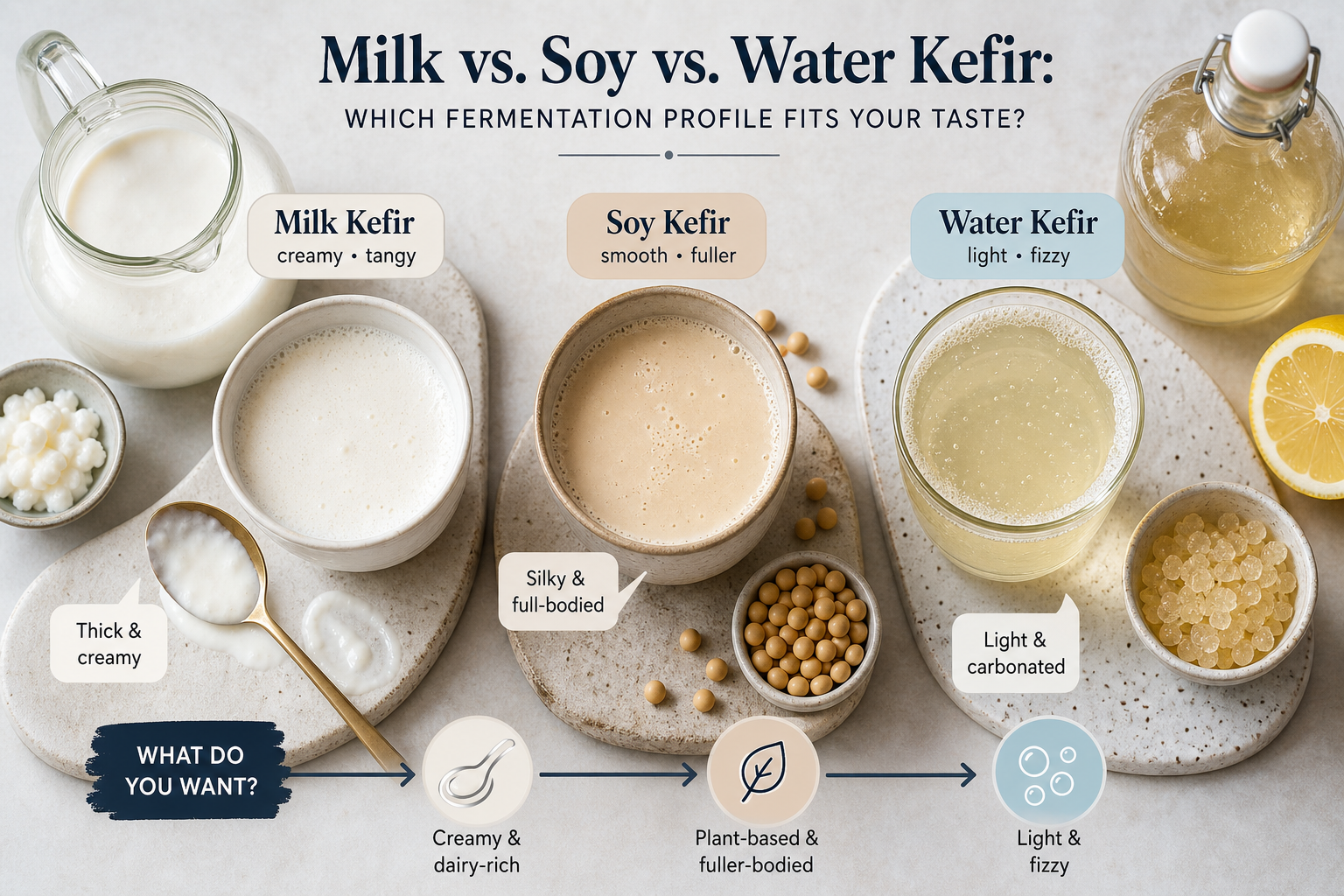
In plain terms, milk supports creamy structure, soy can create plant-based body, and water produces a lighter drink where brightness and refreshment are more obvious. This is why the three drinks can all be called kefir-style fermented beverages while still feeling completely different in the glass.
Fermentation variability caveat: fermentation speed, sourness, texture, and carbonation vary with temperature, starter strength and condition, sugar availability, base composition, and fermentation time. Avoid treating any timing, bubble level, or texture as universal.
Bubbles are one possible cue, not the whole story. Observe aroma, taste, sweetness reduction, acidity, texture, and appearance. Use clean utensils and containers, taste only with a clean spoon, and avoid practices that introduce cross-contamination.
Diet, lifestyle, and sustainability considerations
Your choice may also depend on lifestyle. Milk kefir fits a creamy breakfast or smoothie routine. Soy kefir can work as a plant-based snack drink with more weight than water kefir. Water kefir feels natural as a hot-weather refreshment or a less heavy alternative to a sweet convenience-store drink.
Dietary fit matters too. Milk kefir contains dairy and may still contain lactose. Soy kefir can suit dairy avoidance when the starter and process are compatible. Water kefir is water-based and often useful for dairy-free or vegan preferences, but strict requirements still depend on ingredients and handling.
Sustainability can be one factor, not the whole decision. Broad environmental comparisons from Our World in Data and the World Resources Institute report that plant-based milks, including soy, generally have lower impacts than cow’s milk across greenhouse gas emissions and water use. That is a useful context, but it does not mean every purchase, farm system, package, or supply chain is identical. Choose with taste, dietary needs, access, budget, and values together in mind.
Safety and quality: when not to drink it
Normal fermentation can bring sourness, aroma changes, texture changes, and sometimes separation. Those changes are not automatically a problem. But abnormal signs should be treated seriously.
Safety note: discard any batch with visible mold, rotten odor, unusual colors, or signs of unsafe handling. If you are unsure, do not drink it.
Use clean containers and utensils, avoid cross-contamination, and do not try to “rescue” a questionable batch. Visual appearance alone cannot prove safety. If you have allergies, pregnancy-related concerns, immune-compromising conditions, or serious dietary restrictions, consult qualified healthcare guidance rather than relying on a general article.
A simple way to choose your kefir profile
Ask yourself four questions:
- What texture do I want? Creamy points to milk kefir; fuller plant-based body points to soy kefir; light refreshment points to water kefir.
- Do I avoid dairy? If yes, soy or water may fit better, depending on ingredients and handling.
- When will I drink it? Breakfast and smoothies often favor milk; a plant-based snack drink may favor soy; hot afternoons often favor water kefir.
- Do sustainability values influence my choice? Plant-based bases can be attractive here, while taste and dietary needs still matter.
You do not need to choose one forever. Many people prefer milk kefir in the morning, soy kefir when they want a dairy-free drink with body, and water kefir when they want a cool, lightly fizzy refreshment. That is the point of the fermentation profile menu: creaminess, plant-based body, or refreshing fizz.
Common questions before you choose
Do milk, soy, and water kefir taste similar?
No. The base strongly shapes body, flavor, and fizz. Milk tastes creamy and dairy-tangy, soy has a plant-based soy note and fuller body, and water kefir is lighter and more refreshing.
Do bubbles mean kefir fermented successfully?
Not necessarily. Bubbles are only one cue. Taste, aroma, sweetness reduction, acidity, texture, and the absence of abnormal signs are also important.
Is water kefir dairy-free?
It is water-based, but strict dairy-free or vegan status depends on all ingredients and handling. Check the full process if this matters for you.
Is soy kefir nutritionally the same as dairy kefir?
No. It is better to compare soy kefir by practical traits such as texture, flavor, dietary fit, and plant-based use rather than claiming nutritional equivalence.
Does one type always ferment faster?
No. Fermentation speed depends on temperature, starter condition, sugar availability, base composition, and time. Treat speed as variable, not a fixed ranking.