

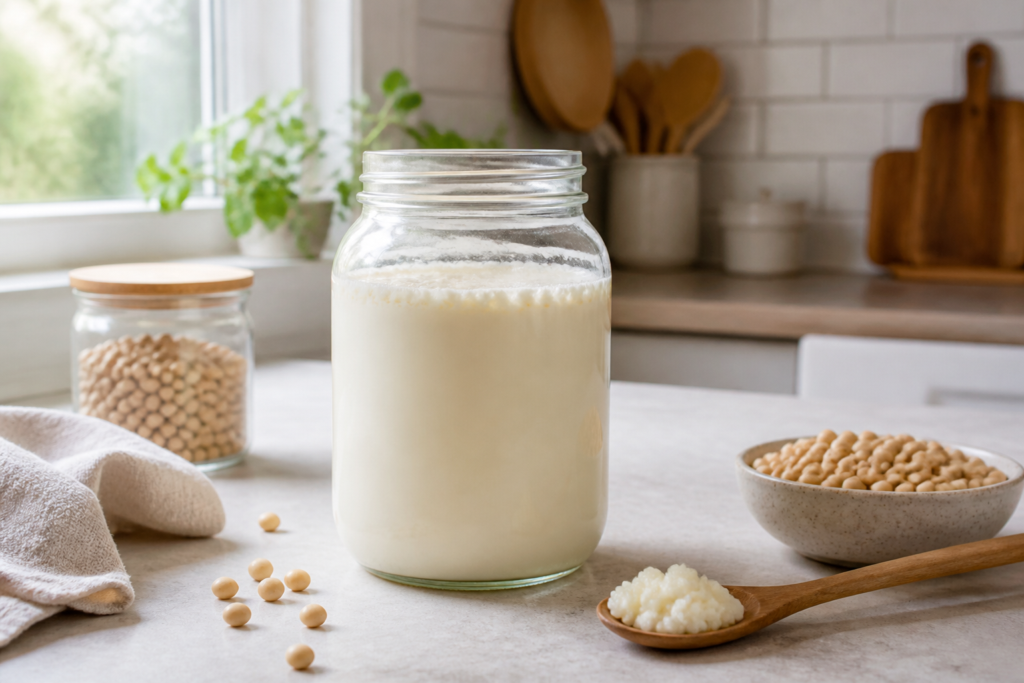
You open a bottle of soy milk kefir, pour a little into a glass, and pause.
It does not smell like the soy milk you drink at breakfast. It is tangier. The texture may be lightly creamy, a little fizzy, or slightly separated near the bottom. If you have heard about soy isoflavones before, the next question is natural: did fermentation change the nutrition, or only the taste?
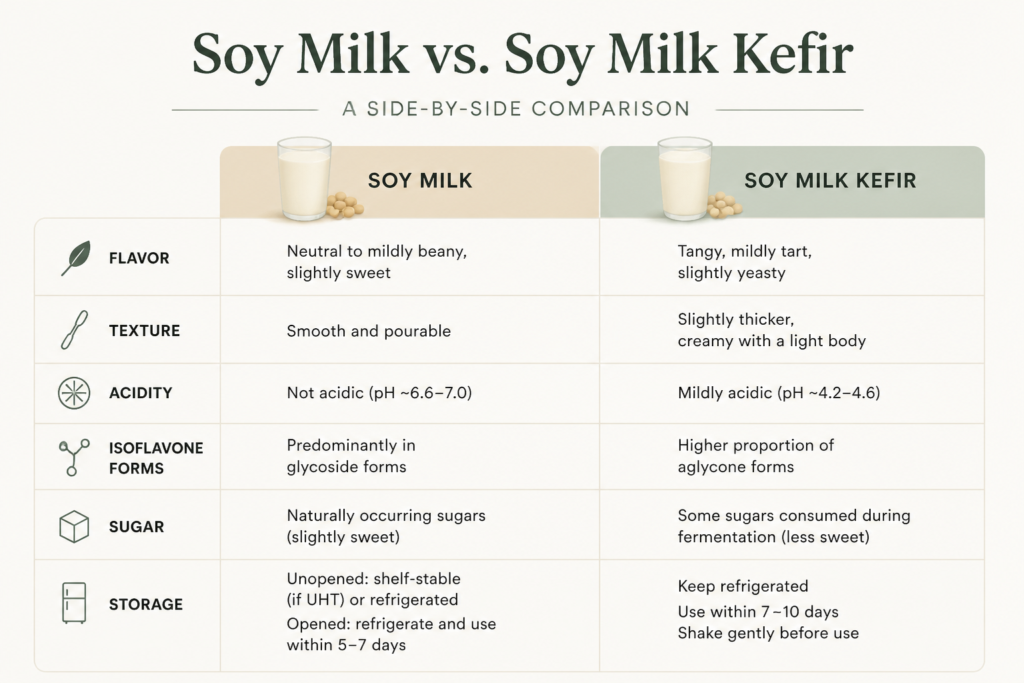
The practical answer is this: fermentation changes acidity, aroma, texture, and some forms of soy compounds such as isoflavones. It does not turn soy milk into medicine, and it does not erase the nutrition label. But it can make soy milk kefir taste and feel very different from regular soy milk.
Quick answer: what changes when soy milk becomes kefir?
- Flavor: it becomes more sour, brighter, and often less “beany.”
- Texture: acidity affects soy proteins, so the drink may become thicker, lightly curdled, or separated.
- Isoflavones: fermentation may convert some isoflavones from bound forms into freer forms, depending on microbes and fermentation conditions.
- Sugar and carbohydrates: microbes use some available sugars, but the final nutrition still depends on the soy milk recipe and any added sugar.
- Safety: keep fermented soy drinks refrigerated, use clean tools, and discard anything with fuzzy mold, rotten odor, unusual colors, or unsafe pressure.
Why this matters when you are choosing a fermented drink
The drink shelf is crowded: sweet soy milk, tea drinks, yogurt drinks, kombucha, sparkling water, and bottled kefir. Soy milk kefir sits in an unusual middle space. It is plant-based like soy milk, fermented like kefir, and usually tangier than most breakfast soy drinks.
That can make the choice less obvious. You may want a dairy-free fermented drink, a lower-sugar option, or a way to compare soy kefir with milk kefir and water kefir. The isoflavone question belongs in that decision, but it should not carry the whole decision. Also check sweetness, sourness, storage, protein, ingredients, and whether the flavor is something you would actually drink more than once.
If you already make milk kefir at home, do not assume soy milk behaves the same way. Milk kefir fermentation depends on milk sugars and dairy proteins. For dairy batches, a basic first fermentation means adding kefir grains to milk, fermenting for about 24 hours, then straining out the grains. If you need to plan a dairy batch, the Milk kefir calculator can help with milk kefir timing. Soy milk still needs close observation because plant milks vary widely.
Research on fermented soy foods and soy milk fermentation often discusses changes in acidity, microbial activity, flavor compounds, and isoflavone forms. For a science starting point, see this PubMed-indexed paper on fermented soy and isoflavone-related changes: pubmed.ncbi.nlm.nih.gov.
Isoflavones, explained without the chemistry fog
Isoflavones are natural plant compounds found in soybeans. In soy foods, common names include daidzin, genistin, glycitin, daidzein, genistein, and glycitein. The spelling looks technical, but the useful idea is simple: some isoflavones are attached to sugar molecules, and some are not.
The attached forms are often called glycosides. The freer forms are often called aglycones. During fermentation, some microorganisms can produce enzymes that split off the sugar part. This may shift the balance from more bound forms toward more free forms. That is a chemistry change, not a promise of a medical effect.
Fermentation results are not identical from one jar to another. Different starter cultures, grains, fermentation times, temperatures, and soy milk bases can create different outcomes. A soy milk kefir made with one culture may not match another brand, another kitchen, or another soy milk recipe. For broader background on fermentation and soy-related compounds, you can read this research listing: pubmed.ncbi.nlm.nih.gov.
If you are coming from dairy kefir, it also helps to understand how much the base ingredient matters. Dairy milk processing affects kefir quality and safety because milk composition matters. For more dairy context, see Milk Matters: How Processing of milk Affects Quality of Kefir.
Why soy milk kefir tastes sharper than regular soy milk
Regular soy milk can taste nutty, mildly sweet, grassy, or beany depending on the soybean, processing method, and sugar level. Fermented soy milk kefir usually tastes brighter and sharper because acids build up during fermentation.
In a real kitchen, the change is easy to notice. Fresh soy milk smells soft and round. After fermentation, the aroma may become tangy, lightly yeasty, or yogurt-like. If carbonation develops in the bottle, the first sip can feel gently lively on the tongue.
Why does it become sour?
Kefir microorganisms consume available sugars and produce acids and aroma compounds. More time usually means more acidity. This is why milk kefir becomes more sour as fermentation time increases, and the same general sensory pattern often appears in soy milk fermentation too.
But soy milk is not dairy milk. It does not contain lactose unless dairy ingredients are added. Some soy milks contain added sugar; others are unsweetened. That sugar difference can affect how active the fermentation seems and how balanced the finished flavor becomes.
Why soy milk kefir can turn thick, grainy, or separated
Soy milk contains plant proteins. When fermentation lowers acidity, those proteins can gather, thicken, and form a soft network. That is one reason soy milk kefir may become creamier than plain soy milk.
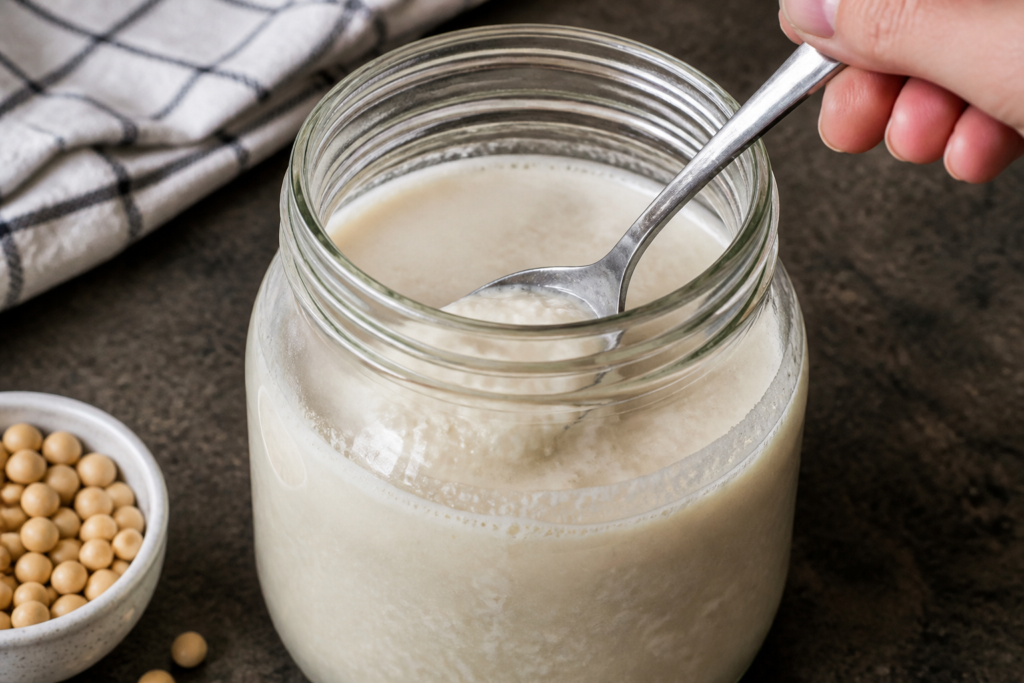
Sometimes the texture is smooth. Sometimes it looks like fine curds. Sometimes a pale liquid layer appears at the top or bottom. Gentle separation is often a normal texture change, especially after refrigeration. If the smell and appearance are otherwise normal, shake or stir before drinking.
Texture changes that can be normal
- Light thickening, similar to a drinkable yogurt texture
- Small fine particles or soft curds
- A tangy aroma without rotten or moldy notes
- Light separation that mixes back together
- Mild fizz if bottled after fermentation
Texture or appearance that should stop you
- Fuzzy growth on the surface
- Pink, orange, black, or green spots
- Rotten, sewage-like, or strongly unpleasant smell
- Sliminess that is unusual for your batch
- A bottle that gushes violently or seems dangerously pressurized
A review article on kefir and fermented milk products gives useful background on kefir microorganisms, acid production, and fermentation behavior: pmc.ncbi.nlm.nih.gov.
What to check on a soy milk kefir label
If you are buying soy milk kefir instead of making it, the label is more useful than broad wellness language. Look for the details that affect taste, storage, and daily use.
| What to check | Why it matters | Practical tip |
|---|---|---|
| Ingredients | Tells you whether it is dairy-free, sweetened, flavored, or mixed with other ingredients. | If you want a simple taste, choose a shorter ingredient list. |
| Sugar | Fermentation may use some sugars, but added sugar still affects the final drink. | Compare per 100 ml, not only per bottle. |
| Protein | Soy milk usually contributes plant protein. | Protein level depends on soybean concentration and recipe. |
| Storage temperature | Fermentation continues slowly when warm. | Choose cold-chain products and refrigerate quickly. |
| Live cultures or fermentation note | Shows whether it is positioned as a fermented drink. | Do not assume every sour soy drink is kefir. |
Most nutrition labels will not list isoflavone forms. Even when research measures them, a normal consumer label usually focuses on calories, protein, fat, carbohydrate, sugar, sodium, and ingredients. So if your question is “how much genistein is in this bottle?”, the standard label may not answer that.
Can you ferment kefir with soy milk at home?
Yes, soy milk can be used for kefir-style fermentation, but it needs more attention than dairy milk. Soy milk brands differ in soybean concentration, added sugar, stabilizers, calcium salts, and flavoring. Those details can change the final thickness and sourness.
If you are using kefir grains that originally came from dairy milk, they may not behave the same forever in plant milk. Many home fermenters give grains periodic dairy refreshment, or use a separate culture for plant milk experiments. For a practical starter guide, read Fermenting kefir with soy milk and other plant milks.
A simple home observation checklist
- Start with clean equipment. Use a clean jar, clean lid or cover, and clean spoon.
- Choose plain soy milk first. Strong flavors and heavy additives make troubleshooting harder.
- Smell before fermenting. Learn the original soy milk aroma so you can notice changes later.
- Watch the texture. Thickening, small curds, and mild separation can be normal.
- Taste carefully. Use a clean spoon. Stop when the sourness is pleasant.
- Refrigerate promptly. Cold storage slows further souring and pressure build-up.
A study on kefir production from soy milk is useful for understanding how soy milk can ferment differently from dairy milk, including acidity and sensory changes: scholarsresearchlibrary.com.
Do milk kefir second-fermentation rules apply to soy milk?
This is where many beginners mix up instructions. In milk kefir, first fermentation means adding kefir grains to milk, fermenting for about 24 hours, then straining out the grains from the finished kefir. Second fermentation means bottling finished fermented kefir and continuing fermentation at room temperature or in the refrigerator.
For milk kefir, the total fermentation time should not exceed 36 hours. For second fermentation, Kefir Link’s milk kefir guidance notes that refrigeration takes about 7 to 48 hours, while Taiwan room-temperature conditions may take about 1 to 6 hours. When first trying second fermentation, open the bottle every few hours and taste with a clean spoon until the flavor is satisfactory. You can read the full guide here: Milk Kefir Second Fermentation.
Those milk kefir times are helpful as a reference for fermentation behavior, but they are not a perfect copy-and-paste rule for soy milk. Plant milk composition changes the speed, texture, and microbial activity. In hot weather, any fermented drink can become sourer and more pressurized faster than expected.
Where Kefir Link fits into the decision
Kefir Link’s role is to help you choose and use fermented drinks safely and realistically. If you are comparing dairy and plant-based options, the key question is not “which one is magically better?” A more useful question is: which base fits your diet, taste, storage habits, and ingredient preferences?
For example, someone who wants a creamy dairy option may prefer Cow’s milk Kefir – Original. Someone avoiding dairy may explore soy milk kefir or water kefir instead. These are food choices, not medical decisions. Choose based on ingredients, cold-chain handling, taste, and how your body usually responds to similar foods.
For ready-to-drink fermented dairy products with fruit, storage matters. Fruit Milk Kefir should be refrigerated at 2–4°C to maintain fermentation balance. That same cold-chain mindset is useful for soy milk kefir too: keep it cold, open carefully, and drink within the recommended period on the product label.
Mistakes to avoid with soy milk kefir and isoflavones
Mistake 1: Assuming “fermented” means unlimited benefits
Fermentation can change food chemistry and taste. It may also change how some compounds appear in laboratory analysis. But that does not mean a product can claim to treat, prevent, or improve a disease. Keep soy milk kefir in the ordinary food category.
Mistake 2: Treating isoflavones like a label promise
Unless a product specifically tests and labels isoflavone content, you usually do not know the exact amount or form. Fermentation may shift isoflavone forms, but the result depends on the soy milk, microbes, time, temperature, and processing.
Mistake 3: Ignoring sugar because the drink is fermented
Some sugar may be consumed during fermentation. Added sugar may still remain. If you are choosing a lower-sugar drink, compare nutrition labels carefully and look at serving size.
Mistake 4: Letting bottles warm up too long
Fermentation is a living process. Warm conditions can speed souring and pressure. In Taiwan room-temperature conditions, milk kefir second fermentation may take only 1 to 6 hours. Soy milk kefir can also change quickly when warm, so do not leave bottles sitting out casually.
When to discard soy milk kefir
Fermented foods have normal variation, but safety comes first. If you are unsure, do not try to “save” a suspicious batch with sugar, fruit, blending, or another fermentation.
- Discard if you see fuzzy mold.
- Discard if you see pink, orange, black, or green patches.
- Discard if the smell is rotten, putrid, or sharply chemical in an abnormal way.
- Discard if the bottle is swollen, leaking, or dangerously pressurized.
- Discard if it was left warm for too long and you cannot confirm safe handling.
If the issue is only normal separation, gentle sourness, or a little sediment, it may simply need shaking or stirring. But visible mold or rotten smell is not a tasting opportunity.
Helpful video: seeing fermented soy milk texture
If you are new to plant-based fermentation, watching the texture can be more useful than reading another description. This video compares fermented soy milk styles and may help you understand why kefir and yogurt-like fermentation do not look exactly the same.
Video source: youtube.com
Should you choose soy milk kefir?
Choose soy milk kefir if you want a plant-based fermented drink with soy protein, a tangy flavor, and a texture that may be creamier than regular soy milk. It is especially worth trying if you like unsweetened soy milk but want something livelier than a standard breakfast drink.
Skip it, or choose another kefir style, if you dislike sour drinks, cannot tolerate soy, or want a product with a very predictable dairy-kefir texture. Milk kefir, soy milk kefir, and water kefir each have a different base, so they will not taste or behave the same.
Your next step
For your first bottle or first home batch, keep the test simple: choose plain soy milk kefir, drink it cold, note the sourness and texture, and compare the sugar and protein on the label. If you ferment at home, use clean tools, track souring through taste and smell, refrigerate early, and discard anything that looks or smells unsafe.
The most useful way to understand soy milk kefir is not to chase one large claim about isoflavones. It is to notice what fermentation actually changes in the cup: acidity, aroma, texture, sweetness, and how well the drink fits your daily routine.