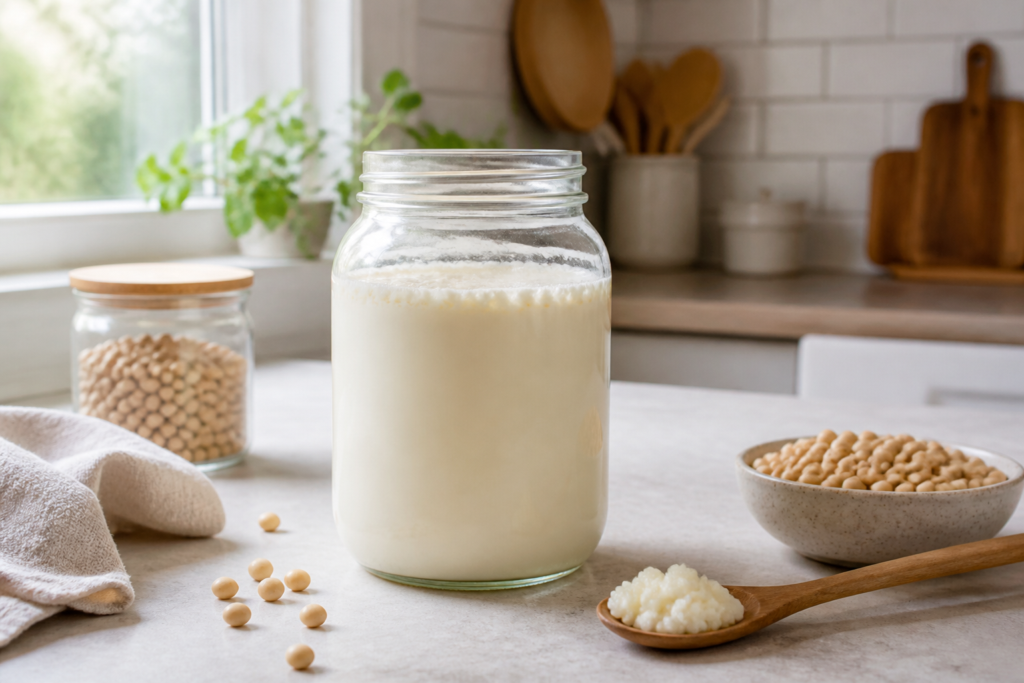


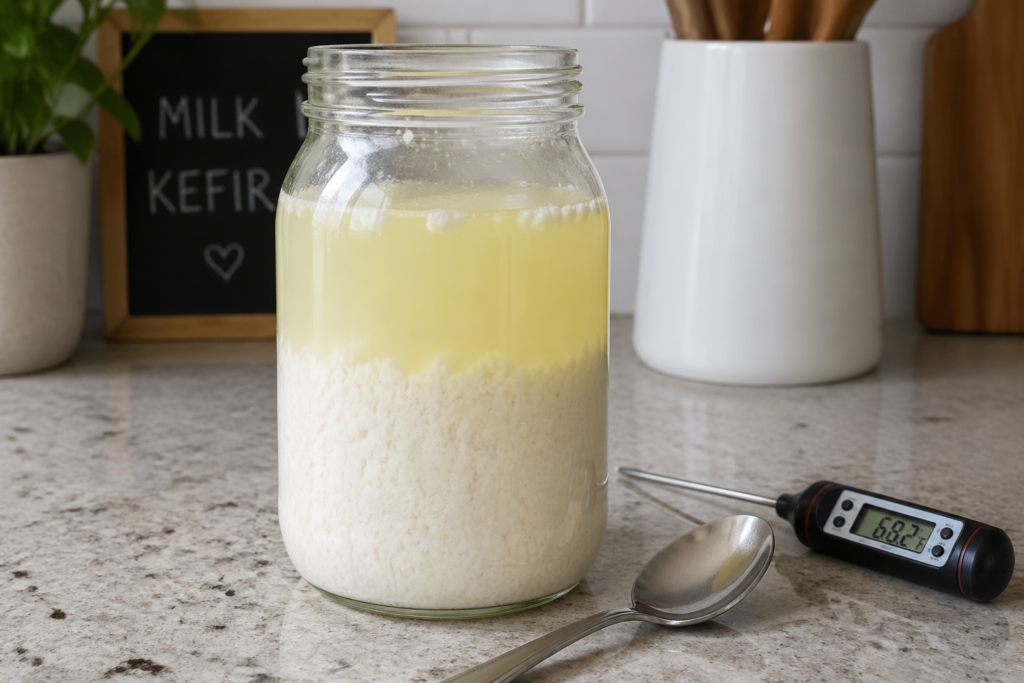
One morning you lift the cloth on your kefir jar and find a scene that looks more like a failed pudding than a creamy drink — a thick white mass floating on top of a pale yellow liquid. Don’t panic. This classic split, called curds and whey, is part of the natural rhythm of milk fermentation. Understanding why it happens helps you regain control of texture instead of guessing whether to keep or toss your batch.
What Curds and Whey Really Mean
When kefir ferments, microorganisms in the grains convert milk sugar (lactose) into lactic acid. As acidity rises, milk proteins (mainly casein) reach their isoelectric point and coagulate — forming curds — while the liquid portion, whey, separates out. This is a normal physical result of acidification, not necessarily spoilage. The whey color can range from milky white to light yellow depending on milk fat and lighting, and that variation alone doesn’t indicate a problem.
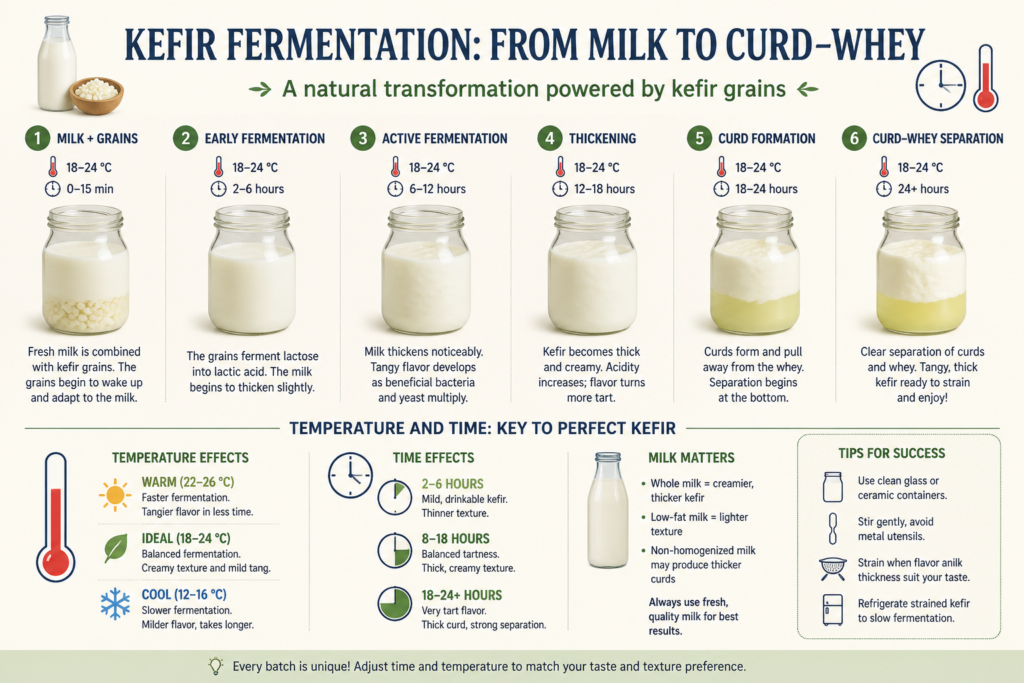
Food microbiology references such as Definition, Characteristics, and Coagulation in Fermented Milks (including kefir) describe this as typical protein precipitation under 18–22 °C fermentation for 18–24 hours. In short: curd‑whey separation simply means the milk has thickened beyond its holding strength.
Why Separation Happens: Temperature, Time, and Milk Factors
At 24 °C room temperature, most kefir reaches a pleasantly thick consistency in about 24 hours. Go longer or warmer, and the acidity climbs faster. The proteins tighten, pushing out whey. Cold conditions slow everything; if fermentation drags on beyond 36 hours and still looks like milk, discard and restart as we note in our step‑by‑step guide.
Milk composition matters too. Whole milk resists separation better than low‑fat milk because fat globules give body and emulsify the structure. As discussed in Milk Matters: How Processing Affects Quality, ultra‑high‑temperature milk or milk powder lacks some native proteins that help form smooth curds, so it tends to split earlier. Fresh, pasteurized milk at moderate temperature gives the most stable texture.
Is It Normal or Over‑Fermented?
A thin layer of whey at the bottom or top is expected once fermentation nears completion. Large pockets of clear liquid and chunkier curds signal over‑fermentation — the same observation described in Is My Kefir Grains Dead?. The taste will be sharply sour but still usable for cooking or second fermentation if it smells clean and fermented, not rotten or moldy.
If the whey appears translucent yellow and the curds look like cottage cheese, you’ve simply gone a few hours too long. If it smells off, discard it and refresh your grains with fresh milk. Remember that whey from fermentations left dormant in the fridge for weeks, as mentioned in our storage guide, is not suitable for consumption.
How to Stir, Strain, or Blend to Restore Texture
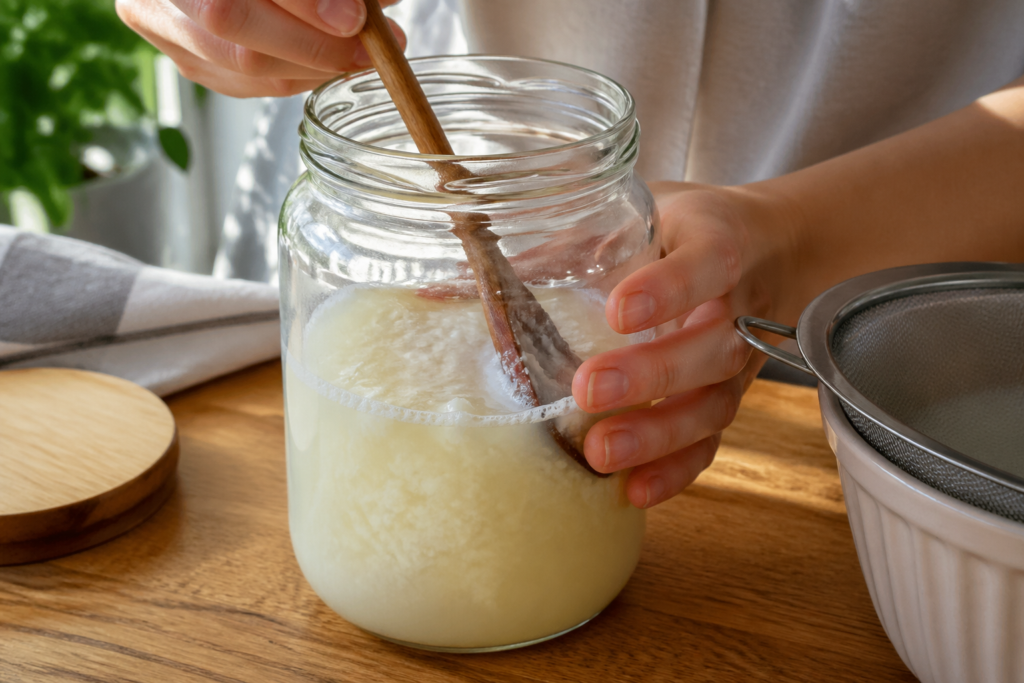
Once separation starts, give the jar a gentle stir or swirl before straining. This re‑mixes some whey with the curds, loosening the texture so it passes more easily through a plastic sieve. After removing the grains, you can shake or blend the finished kefir for a smooth drink‑like consistency. The study on polysaccharide production by kefir grains notes that exopolysaccharides produced during fermentation influence viscosity — agitation helps redistribute these natural thickeners evenly.
If you prefer a thicker spoonable kefir, skip blending and refrigerate directly; cooling will further firm the curds. For a lighter drink, blend or whisk the whey back in. Either way, the taste difference mainly comes from acidity and fat content, not from spoilage.
Preventing Future Separation: Practical Fermentation Adjustments
- Adjust time: Stop fermentation when you first see small whey pockets at the jar bottom. That’s the sweet spot before full separation.
- Control temperature: Keep the jar between 20 °C and 26 °C. Warmer kitchens may need shorter times or smaller grain ratios.
- Use proper milk: Choose fresh pasteurized whole milk with stable protein and fat content. Avoid long‑life or reconstituted milk powders.
- Stir mid‑fermentation: A gentle swirl halfway through helps equalize acidity and temperature, reducing uneven curd formation.
- Know when to pause: If you can’t keep up daily batches, refrigerate your grains to slow fermentation safely — see our guide on pausing kefir.
Following these small adjustments helps you tune the balance between curds and whey instead of being surprised by them. Separation is not a failure — it’s a fermentation signal telling you exactly where your kefir stands.
Sources and Further Reading
- Definition, Characteristics, and Coagulation in Fermented Milks (including kefir) – ScienceDirect / Encyclopedia of Food Microbiology
- Kefir as a Functional Dairy Product: Composition, Fermentation Conditions, and Texture – ScienceDirect / Encyclopedia of Dairy Sciences
- Polysaccharide production by kefir grains during whey fermentation – Journal of Dairy Research via PubMed