








Water Kefir Grains Starter Kit|100g
NT$999
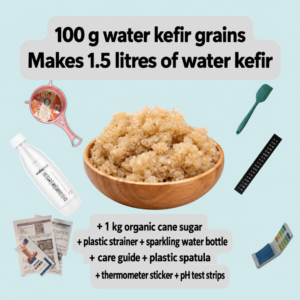
- 100 g of active water kefir grains: enough for about 1.5 litres on the day they arrive.
- Make naturally sparkling probiotic drinks at home. Add fruit for a second fermentation and you get a fruit soda that fizzes when you open it.
- SGS tested: the water kefir we make contains over 300 million active lactic acid bacteria per 330 ml bottle.
- Vegan, lactose-free and caffeine-free, with no tea needed.
- Comes with 1 kg of organic cane sugar and a sparkling-water bottle for the second fermentation. With the grains, the sugar makes about 16 litres.
Out of stock




 Cash on delivery
 Bank transfer
Water kefir grains
Crystal-like grains that turn sugar water into a sparkling drink
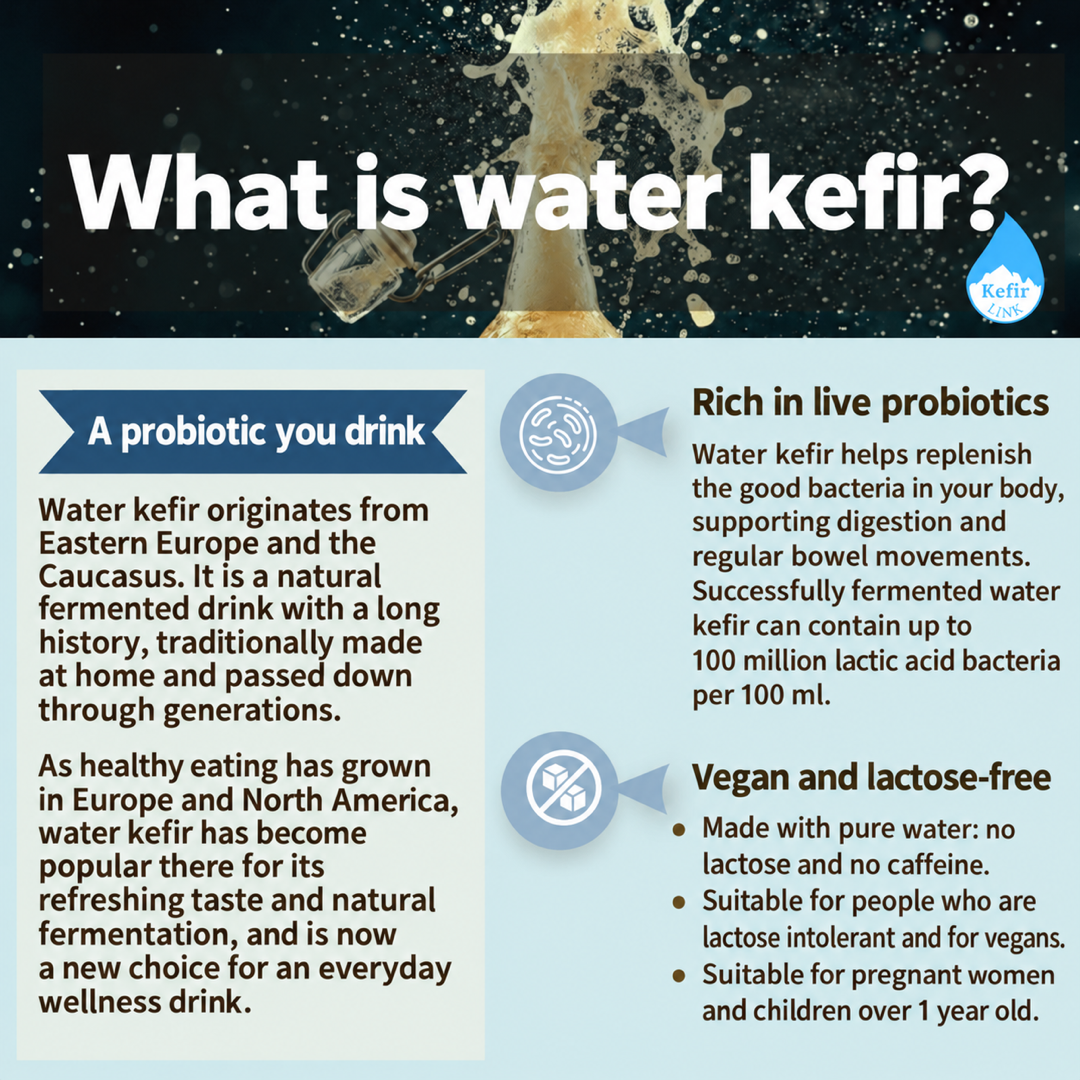
Water kefir grains are small translucent clusters in which lactic acid bacteria and yeasts live together. They look like little crystals. Put them in sugar water and leave the jar at room temperature for a day or two: the grains eat most of the sugar and turn it into a lightly sweet, lightly tart and refreshing drink. Bottle it with fruit, and natural bubbles form.
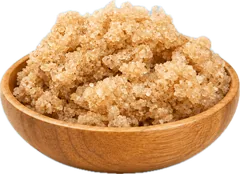
- Sugar water
- 24 to 48 hours
- A lightly tart drink
- Bottled with fruit
- Natural soda
The grains are never used up
After each batch, strain the grains out and put them in fresh sugar water for the next one, every one to two days. The grains slowly grow and multiply, and you can share the extra with friends.
Vegan, lactose-free, caffeine-free
It is fermented from water, sugar and grains only, with no milk and no tea. You can enjoy it at any time of day, and the whole family can share it.
Not the same as milk kefir grains
Water kefir grains live on sugar water and need different care from milk kefir. If you have made milk kefir before, set that experience aside and start fresh with this page and the guide.
What’s in the box
Open the parcel: nearly everything for your first batch is inside
Tap an item to see what it is for. Wash new tools with soap before the first use and dry them completely, with no water spots left.
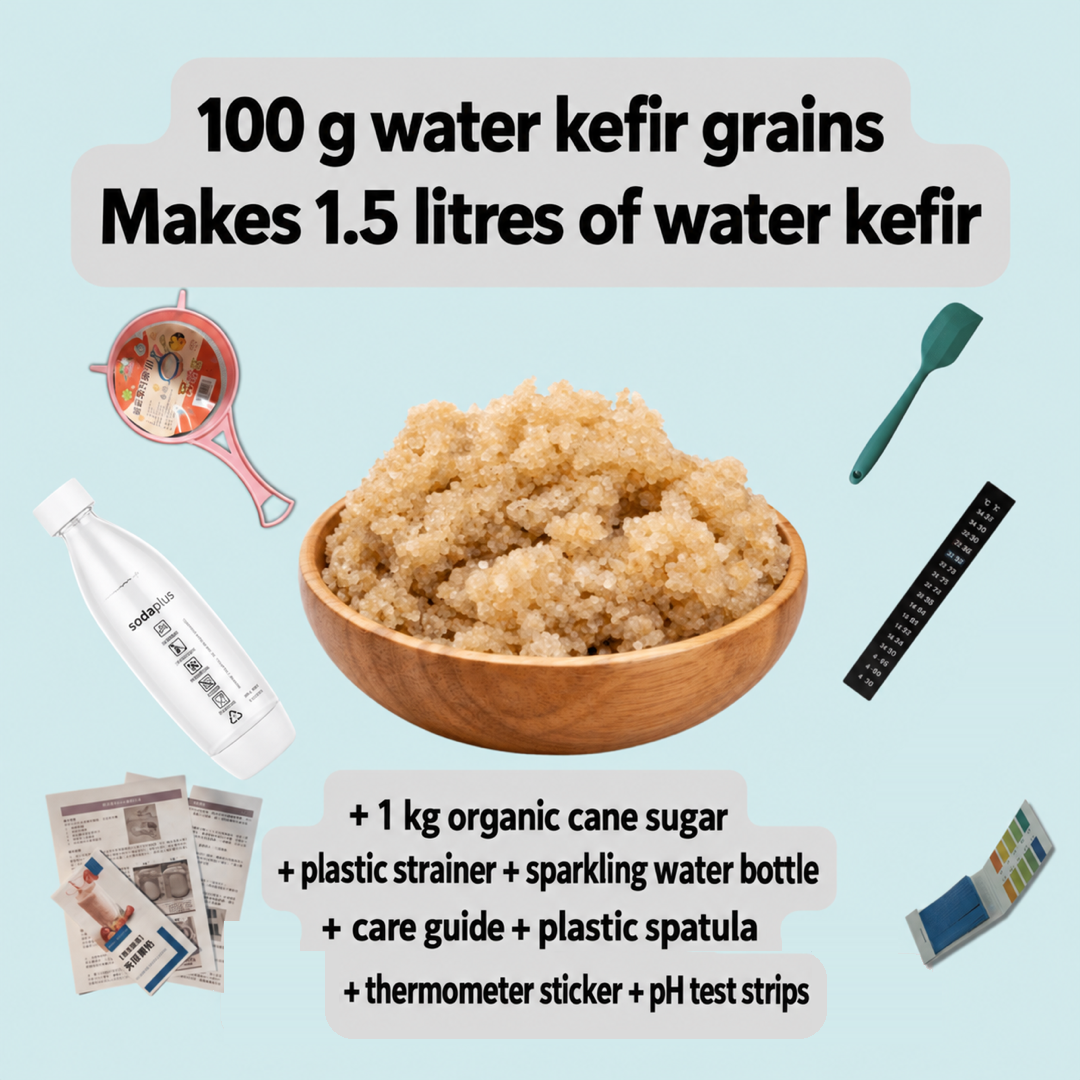
100 g water kefir grains
- The grains travel in sugar water and go by chilled delivery, away from Taiwan’s heat.
- Open the parcel soon after it arrives and strain out the grains. The clear or thick liquid in the jar was the grains’ sugar water for the journey: pour it away instead of drinking it.
- At the guide’s ratio of 30 g of grains to 500 ml of sugar water, 100 g makes about 1.5 litres a batch.
1 kg organic cane sugar
- Sugar is the grains’ food: they live and grow on it, and it is what makes the bubbles.
- Organic cane sugar keeps the cane’s trace minerals, which the grains like. When you buy sugar yourself later, golden granulated sugar (二砂) is the best everyday choice.
- Each 500 ml takes 30 g of sugar, so 1 kg makes about 16 litres.
Sparkling-water bottle
- This pressure-safe plastic bottle is for the second fermentation. Pour in the strained water kefir with fruit and close it tightly, and the bubbles stay in the bottle.
- Plastic flexes instead of shattering like glass, which makes it the safest choice for beginners. Squeeze the bottle: the firmer it gets, the more fizz has built up.
- Fill it about 70 to 80 percent full, leaving room for the gas.
Plastic strainer
- It separates the finished drink from the grains. The grains stay in the mesh, ready to go straight into fresh sugar water.
- Use the plastic strainer for everyday straining. An acidic drink left in metal for a long time corrodes the metal.
Silicone spatula
- When you pour out the grains, scrape the ones stuck to the sides and bottom of the jar, so none are left behind.
Thermometer sticker
- Stick it on the outside of the jar to see the temperature around the grains at a glance.
- 20 to 25 °C suits them best. Above 30 °C, move the jar to the coolest spot at home and harvest earlier.
pH strips
- The strips show how far the fermentation has gone. They are especially helpful for your first batches.
- Put a little finished water kefir on a strip, wait 10 to 15 seconds without shaking off the extra liquid, then compare it with the colour chart.
- The strip starts dark blue. Green means the batch is just right, and yellow means it fermented longer and tastes more sour.
10-page guide
- It covers choosing water and sugar, the first and second fermentation, storage, resting the grains and common problems, all with pictures.
- If you still have a question, ask us on LINE any time.
You only add a clear 1-litre glass jar, a plastic or wooden spoon, kitchen paper or a coffee filter, a rubber band, and boiled-and-cooled water or mineral water.
Water and sugar
The right water and sugar keep the grains healthy
This is where people in Taiwan most often go wrong. Pick the water and sugar you have at home, and you will see straight away whether it works, why, and what to do.
Good to useBoiled and cooled tap water
Boiling tap water drives off its chlorine. Tap water in Taiwan usually holds enough minerals, so this is a very good choice.
Let it cool to 20 to 25 °C before adding the grains.
Good to useMineral water
Mineral water naturally contains calcium and magnesium, which the grains need to keep their structure. It is an excellent choice.
Use it as it is; no added minerals needed.
Use with careRO (reverse-osmosis) water
RO water is filtered so thoroughly that it has no minerals left. Used for a long time, it makes the grains soft until they fall apart.
Add minerals to every batch: ½ teaspoon of dark brown sugar, a small piece of dried eggshell and a tiny pinch of sea salt (under 0.5 g per litre).
Don’t useDistilled water
Distilled water has no minerals at all, so the grains grow weaker and weaker.
Use boiled-and-cooled tap water or mineral water instead.
Don’t useTap water straight from the tap
Tap water contains chlorine. Chlorine is there to kill germs, and it also kills the good bacteria in the grains.
Boil it and let it cool: then it is the best water you can use.
Good to useGolden granulated sugar (二砂)
Golden granulated sugar has a light cane aroma and trace minerals. The grains thrive on it, and it is the first choice for everyday brewing.
Use 30 g for every 500 ml.
Good to useOrganic cane sugar (in the kit)
Organic cane sugar keeps the cane’s trace elements, which the grains like.
Use 30 g for every 500 ml.
Use with careDark brown sugar or molasses
Dark brown sugar and molasses are very rich in calcium, magnesium and potassium, which makes them a good supplement. Brewed on dark brown sugar alone, the excess minerals make the fermentation run wild and the liquid turns thick and slimy: harmless, but unpleasant to drink.
Add only ½ teaspoon per batch as a supplement, about one tenth of the sugar; use golden or organic cane sugar for the rest.
Use with careCoconut sugar or maple syrup
They are so nutrient-rich that the yeasts grow too fast and upset the balance of the grains.
Fine once in a while; use golden or organic cane sugar day to day.
Don’t useHoney
Honey contains natural antibacterial compounds that hold back and can even kill water kefir grains.
If you like the taste of honey, stir a little into your glass just before drinking.
Don’t useSweeteners (erythritol, stevia and others)
Sweeteners are not real sugar. The grains cannot eat them and starve.
Use golden or organic cane sugar: the grains eat most of it while fermenting.
A little “vitamin” for the grains in every batch
1 or 2 unoiled raisins or dried figs
They feed the yeasts and liven up the fermentation. Choose dried fruit with no oil and no sulphur treatment, because sulphur dioxide holds fermentation back.
A small piece of dried eggshell
Eggshell is natural calcium carbonate. It firms up the grains and keeps the acidity from dropping too fast. Wash the shell, dry it in the air or the oven, and crumble half of it into the jar.
½ teaspoon of dark brown sugar
It adds calcium, magnesium and potassium. These supplements matter most when your water is soft.
How to make it
Two fermentations to a naturally fizzy soda
In the first fermentation the grains turn sugar water into a lightly tart drink in a glass jar. In the second, you bottle that drink with fruit and close it tightly: this is the step that makes the bubbles and the fruit flavour. This example makes 500 ml; wash the tools with soap and dry them completely first, with no water spots left.
First fermentation: in a glass jar, every one to two days
- 1
Make the sugar water
Dissolve 30 g of sugar in about 100 ml of hot water, then add cool water up to about 500 ml so the sugar water comes down to room temperature, 20 to 25 °C. Always let it cool: hot water kills the grains.
- 2
Add the grains and a little extra
Put 30 g of grains into the cooled sugar water. We suggest adding ½ teaspoon of dark brown sugar, one raisin and a small piece of dried eggshell for minerals and nourishment.
- 3
Cover with paper, never seal it
Cover the mouth with kitchen paper or a breathable cloth and hold it with a rubber band so fruit flies and ants stay out. The grains need to breathe during the first fermentation, so don’t put a lid on.
- 4
24 to 48 hours somewhere cool and shady
Keep it out of direct sun. In hot weather it takes about 24 hours, in cold weather about 48; the tool below works out the time for your room temperature.
- 5
Check it, then harvest
Small bubbles rise, the sweetness has clearly dropped and it tastes a little tart: once the strip reads pH 3.5 to 4.5, it is ready. Strain out the grains. The liquid is first-fermentation water kefir: drink it as it is, or go on to the second fermentation. The grains need no washing and go straight into fresh sugar water for the next batch.
Second fermentation: in the bottle, for fizz and fruit flavour
- 6
Bottle it with fruit
Pour the strained water kefir into the sparkling-water bottle, about 70 to 80 percent full, leaving room for the gas, then add fruit, juice or unpeeled ginger, for example 50 to 100 ml of juice per 500 ml. The drink still holds yeasts and lactic acid bacteria, and the sugar in the fruit is fresh food for them: that is where the bubbles and the fruit flavour come from.
- 7
Close it tightly: 12 to 24 hours at room temperature
With the cap tight, the gas cannot escape and dissolves into the drink as bubbles. Open the cap a little once or twice to let some gas out, then close it again. In summer 8 to 12 hours may be enough; squeeze the bottle, and when it feels firm, the fizz is there.
- 8
Chill it, then open it
Chill it well in the fridge before opening: cold bubbles are calmer and finer and less likely to gush. Point the bottle at the sink, never at anyone, and turn the cap slowly with a clean cloth over it.
Amounts and timing
How much do you want, and when can you drink it?
Choose how much you want, how warm your room is and the flavour you’d like. You’ll see how much sugar, water and grains to use, and a timeline from now with the reason for every step.
The full method and troubleshooting are in the guide; ask us on LINE any time.
Did it work?
Look, smell, taste, then check with a strip
Look
Small bubbles rise, and the liquid turns slightly cloudy when you gently swirl the jar.
Smell
It smells fresh and slightly sour, with a fermented note; a hint of bread yeast is normal too.
Taste
The sweetness has clearly dropped, and it tastes sweet and tart.
Fermentation map: tap to see where your batch is
pH 7.0–6.0Start
Sweet like sugar water.
It has just begun, so be patient. Fresh sugar water should read 6.0 to 7.0; if it doesn’t, check your water.
pH 6.0–5.0Waking up
Still very sweet, with a hint of tartness.
The grains have just started working. Keep waiting.
pH 5.0–4.0Active
Noticeably less sweet, with tartness and bubbles.
Nearly there. If you like it light, harvest now.
pH 4.0–3.5Golden point
Balanced sweet and tart, and refreshing.
The best time to harvest, when the probiotic count is highest.
pH 3.5–3.0Late
Very tart and hardly sweet.
Harvest soon. Fans of a vinegar-like tang will enjoy it, but don’t leave the grains in it long.
pH 3.0–2.5Over-fermented
Sharp like vinegar.
Harvest now: the grains are starving and need fresh sugar water. The liquid is still fine to drink, or use it like vinegar in cooking.
Put a little water kefir on a strip, wait 10 to 15 seconds without shaking off the extra liquid, then compare it with the chart on the pack.
Fresh smell and pH below 4.5
The acidity strongly holds back harmful bacteria, and finished water kefir usually sits between pH 3.0 and 4.0. Test your first batches with a strip; after a while you’ll know by feel.
A foul smell, mould, or anything that looks wrong
Whatever the pH, pour it all away, grains included, and wash the jar thoroughly. Send us a photo on LINE and we’ll tell you what to do next.
Second fermentation
Second fermentation: the right bottle and a flavour
Steps 6 to 8 above are the second fermentation. It builds a lot of gas and pressure, so the bottle has to be the right one; the flavour is up to you, and below is how much to add per 500 ml.
Which bottle?
The kit’s sparkling-water bottle
A pressure-safe plastic bottle, our top pick for beginners.
A PET soda bottle
It was made for fizzy drinks, and a squeeze tells you how much fizz has built up.
Square glass bottles
The corners are weak points and burst under pressure.
Thin decorative glass bottles
They can’t take the pressure and crack.
Mason jars
The flat lid can blow off under pressure.
Ordinary water jugs
They are not made for pressure and can break.

Give it a squeeze: the firmer the bottle, the more fizz inside. Once it barely gives, move it to the fridge.
How much per 500 ml?
Fruit juice 50–100 ml
Passion fruit, pineapple, orange or grape juice all work. It gives the fastest and steadiest fizz, because the sugar in the juice keeps the fermentation going.
Fruit purée 2–3 tbsp
Berry or mango purée fizzes very fast, though you may get a little pulp when you pour.
Fruit slices 1–5 thin slices
Thin slices of lemon, apple or strawberry release flavour more slowly but look beautiful in the bottle.
Unpeeled ginger 2–3 thin slices
The wild yeasts on ginger skin make the bubbles take off, giving you a natural ginger soda.
Fresh herbs 1 small sprig
Mint or rosemary adds an elegant aroma and tastes best together with fruit.
When it arrives
The parcel is here: three steps to get started
 1
Open the parcel soon
The grains travel chilled in sugar water, feeding on it as they rest on the way. Once it is delivered or you get the pickup notice, bring it home soon, open it and give the grains fresh sugar water.
- 2
Strain the grains; pour away the travel liquid
Strain out the grains. The clear or thick liquid in the jar was their food for the journey: pour it away, don’t drink it. Wash the tools with soap and dry them completely first.
- 3
Give the first batches some time
After the long journey the grains are a little tired. The first 3 to 7 batches (about one or two weeks) ferment more slowly with fewer bubbles, and that is normal. Keep changing the sugar water on time and be patient: the grains will get their energy back.



Everyday care
Six things your grains like
20 to 25 °C, out of the sun
This is the perfect range. Above 30 °C the yeasts run wild, so in summer keep the jar in the coolest spot at home and shorten the fermentation.
Never heat them
Water kefir ferments at room temperature, and 35 °C or more kills the grains. Never put them in a yogurt maker, rice cooker, oven or any heating appliance.
No need to rinse the grains
Rinsing too much washes off their protective film, so move them straight into fresh sugar water. Only rinse them gently with cooled boiled water if they smell odd.
Save the fruit for the second fermentation
Fruit in the first fermentation soils the grains, and pulp gets stuck between them. Add fruit after the grains have been strained out.
Plastic or wooden tools
A quick stir with a metal spoon is fine. What to avoid is leaving it in a metal container for long, because the acid corrodes metal. Use the plastic strainer for everyday straining.
Keep the finished drink in the fridge
Water kefir from the first fermentation keeps in the fridge for up to 45 days. It keeps fermenting slowly in the cold and gets more tart the longer it waits.
Going away? Let the grains rest
Fridge rest, 2 to 3 weeks
Make fresh sugar water with a little extra sugar as a reserve, add the grains, close the lid and put the jar in the fridge. When you’re back, pour off the old water and ferment in fresh room-temperature sugar water for 24 to 48 hours. The first batch usually tastes off, so pour it away; the second is back to normal.
Dried, 6 months or more
Rinse the grains gently with cooled boiled water, spread them on baking paper and air-dry them, or use a food dehydrator at 30 °C, for 2 to 5 days until they are hard little yellow grains. Keep them in a sealed bag in the fridge. To wake them, change the sugar water every day; in about 3 to 7 days they swell and start to bubble.
More grains than you need
Give the extra grains to friends, or eat them: they are like soft jelly with little taste. Add them to smoothies or yogurt, share them with your pets, or put them in the compost.
Troubleshooting
Something looks odd? Start here
Pick what you see. If you’re not sure, send us a photo on LINE before you throw any grains away.
No bubbles in the first fermentation
That is normal. The first fermentation is covered with breathable paper, so the gas escapes. The bubbles form in the sealed bottle during the second fermentation.
No bubbles after the second fermentation
There may be too little sugar, a loose cap, too much cold, or grains that haven’t recovered yet. Next time add a little more juice or ½ teaspoon of sugar, check the cap’s seal isn’t worn, and keep the bottle above 20 °C.
Still like sugar water at 48 hours
The grains may be dormant or weak. Grains that have just arrived are slow for the first 3 to 7 batches, and that is normal. Try once more with fresh sugar water and one or two raisins. If after another 48 hours there are still no bubbles, no tartness and the pH is still above 5.5, send us a photo on LINE.
Too sour, like vinegar
It fermented too long and the pH is below 3.5. Harvest earlier next time. This batch is still safe: dilute it with water to drink, or use it in salad dressing.
The bottle keeps gushing
Too much sugar, too much heat or too long. Next time use less juice and shorten the second fermentation; in summer 8 to 12 hours may be enough. Always use a plastic bottle and open it well chilled.
Thick, stringy liquid
With plenty of minerals, the grains make a polysaccharide gel. It means the grains are healthy, but it feels odd to drink. Leave out the dark brown sugar and eggshell for 3 or 4 batches and use golden or organic cane sugar; the thickness goes away.
Smells like rotten eggs
The yeasts are stressed, usually from too little nourishment or air. Add two or three raisins, swirl the jar gently every day to let in some air, and harvest earlier, at 24 hours.
Smells like nail-polish remover
It is too warm (above 30 °C) and the yeasts have run wild. Move the jar somewhere cool, shorten the fermentation to 24 hours and change the sugar water often until the smell is gone.
A white, wrinkly film on top
This is kahm yeast: harmless, but it tastes bitter. Skim it off with a spoon and make sure the cover is tight so less air gets in.
Green, black or pink fuzzy spots
This is mould, and it has spread into the liquid. Pour away the whole jar, grains and liquid, and wash the jar thoroughly. Within 30 days of delivery, send us a photo on LINE and we send you a new portion of grains free; you pay the shipping.
Grains getting small or breaking up
The water is too soft and lacks minerals, or the stirring is too rough. Switch to mineral water (always add minerals to RO water), add ½ teaspoon of dark brown sugar and eggshell to each batch, handle them gently and don’t stir with metal.
The grains aren’t growing
This is common with newly arrived grains, or when conditions aren’t ideal yet, and recovery can take a few weeks. As long as there are bubbles, the taste turns tart and the pH drops, the grains are alive.
Second fermentation: fizz, flavour and bottle pressure ›Five secrets about water kefir ›
Our promise
For your first batches, we’re here
A new portion within 30 days
Follow the guide. If the grains sadly fail to grow within 30 days, send us a photo on LINE and we send you a new portion free; you pay the shipping. Grains killed by a yogurt maker, rice cooker, microwave or any other heating appliance are not covered.
A real person on LINE
Not sure it’s going right? Send a photo and we’ll tell you what to do next.
A 10-page guide
From the first and second fermentation to storage and troubleshooting, all with pictures.
At a glance
Want to taste it first, or make milk kefir?
Make it yourself
 Water kefir starter kit
- Buy grains once, brew at home
- 1 kg organic cane sugar and a bottle included
Taste it first
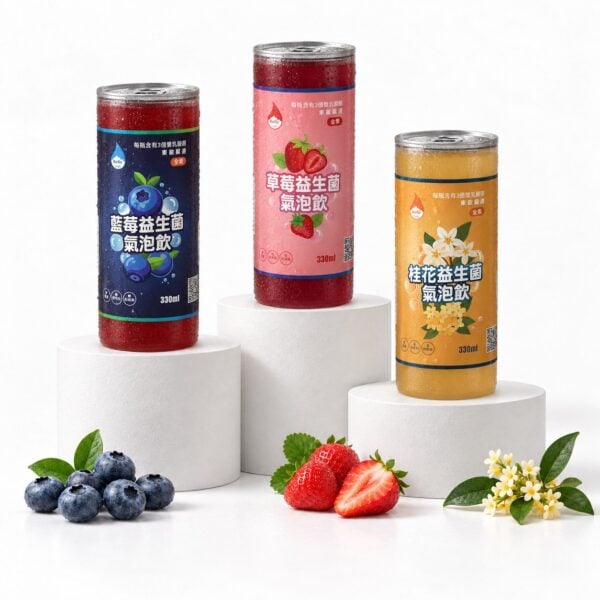 Water kefir sparkling drink
- Water kefir we brew for you
- Blueberry, osmanthus and strawberry
A whole box
 Water kefir free-shipping box
- 20 or 30 cans, shipped free
- Mix the three flavours
Make milk kefir
 Milk kefir grains
- Turns fresh milk into kefir
- Tools and a manual included
Delivery & payment
Kept cold all the way: home delivery or 7-ELEVEN pickup
Three chilled options on Taiwan’s main island, and chilled delivery to Penghu, Kinmen and Matsu. Choose your date at checkout.


HCT chilled home delivery
NT$150 · free from NT$999
Pick a delivery date and a preferred time window (a guide for the driver); no delivery on national holidays


Black Cat chilled home delivery
NT$160 · NT$80 from NT$1,300
Pick a date and morning or afternoon; usually no Sunday delivery


Black Cat 7-ELEVEN chilled pickup
NT$160 · NT$80 from NT$1,300
Choose a store near you; you get an SMS when it arrives
- Penghu, Kinmen and Matsu tooBlack Cat chilled home delivery, NT$320 per order (no free-shipping threshold, no cash on delivery).
- Pick a delivery date at checkoutThe carrier aims for that date; Sundays and public holidays can delay it.
- Tracking number by emailWe also email you when it is out for delivery, at the store or delivered.
- Defective, wrong or damaged? Resent or refundedSend photos of the parcel and product on LINE within 72 hours; we cover the shipping.
Payment
Card · LINE Pay · cash on delivery · bank transferFull delivery information ›Payment details ›Returns policy ›
FAQ
What customers ask us most
What does water kefir taste like?
Like a lightly sweet, lightly tart lemonade, somewhere between lemon soda and kombucha, but less sour and sharp than kombucha. After a second fermentation with fruit, it is a natural fruit soda.
With all that sugar, is it very sweet?
The sugar water starts at about 6 percent sugar, but during the 24 to 48 hours of fermentation the grains eat most of it to grow and make bubbles. The result is refreshing and only lightly sweet, and the longer it ferments, the less sweet and the more tart it gets.
Does water kefir contain alcohol?
Yeasts naturally make a trace of alcohol while fermenting, usually under 0.5 percent; this is normal in natural fermentation. Longer or warmer fermentation raises it a little. If you are especially sensitive to alcohol (for example during pregnancy, or for children), shorten the fermentation to 24 hours.
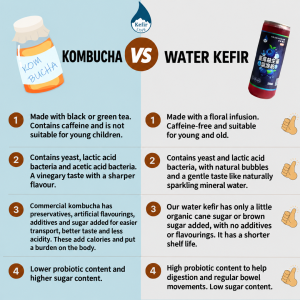
How is it different from kombucha?
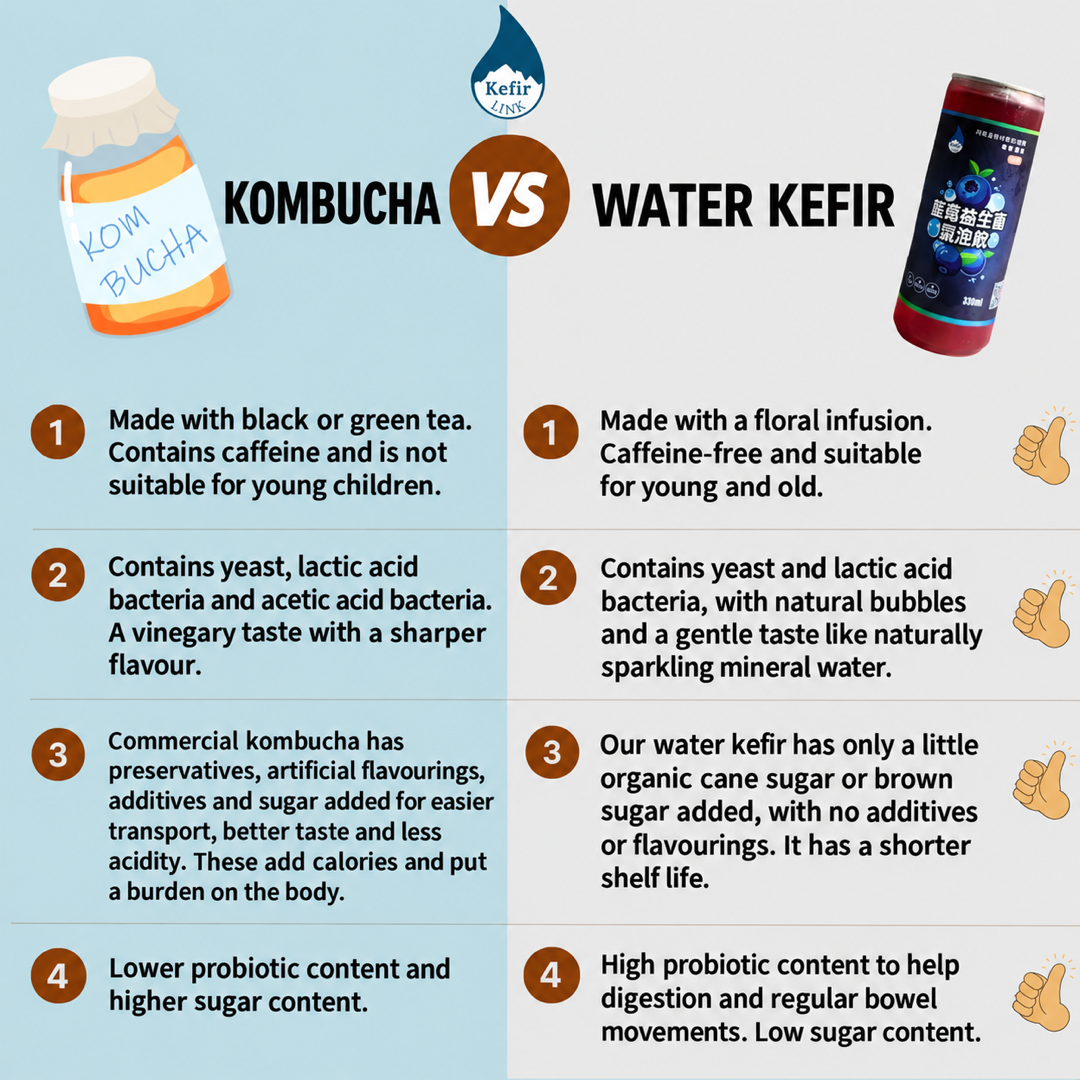
Kombucha is fermented from black or green tea, contains caffeine and has a clearer vinegar note. Water kefir is fermented from water and sugar alone, is caffeine-free and tastes lighter and more refreshing.
How much do 100 g of grains and 1 kg of sugar make?
At the guide’s ratio (30 g of grains and 30 g of sugar for 500 ml), you can make about 1.5 litres on the day it arrives, and the 1 kg of organic cane sugar makes about 16 litres in all. The grains slowly multiply, so your batches can grow too.
I started my new grains, but nothing is happening.
That is normal “shipping shock”. The grains are tired after the long journey, so give them 3 to 7 batches (about one or two weeks) to recover. Just keep changing the sugar water on time and be patient.
Do I need to rinse the grains every time?
No. Rinsing too much washes off their protective film, so move them straight into fresh sugar water. Only rinse them with cooled boiled water if they smell odd.
Can I use a metal spoon?
A quick stir is fine. What to avoid is long contact with a metal container, because the acid corrodes metal. Use the plastic strainer for everyday straining.
Can I add fruit in the first fermentation?
We don’t recommend it. Fruit in the first fermentation soils the grains, and pulp gets stuck between them. Add fruit in the second fermentation, after the grains are strained out.
Why does every batch taste different?
That is normal. Water kefir grains are a living community, and the taste changes with temperature, water and season. That is the fun of fermenting.
How do I know if the grains have died?
If 48 hours after fresh sugar water the pH is still above 5.5, it tastes not at all tart and there are no bubbles, try once more. If that happens twice in a row the grains may have died; send us a photo on LINE.
Can I keep them warm in a yogurt maker or rice cooker?
No. Water kefir ferments at room temperature, and 35 °C or more kills the grains. Keep them out of yogurt makers, rice cookers, ovens and other heating appliances; grains killed by heat cannot be replaced for free.
I’ve made milk kefir. Is it the same?
No. Water kefir grains are a completely different culture: they live on sugar water, not milk, and need different care. Set your old experience aside and start like a beginner with this page and the guide.