


 By Nik, founder of 東歐嚴選|kefir.link and former chef · Published 12 November 2026
“Which bacteria are in your kefir?” “Why are the strains not listed on the bottle?” We hear these two questions on LINE almost every week, and they are fair questions. Yogurt in the supermarket lists its cultures, and everyone says to check the strain code when buying probiotics. Kefir is different because nobody chooses its bacteria. It is fermented with kefir grains, a living community of bacteria and yeasts that is a little different in every kitchen in the world, and a little different in every batch.
The short answer
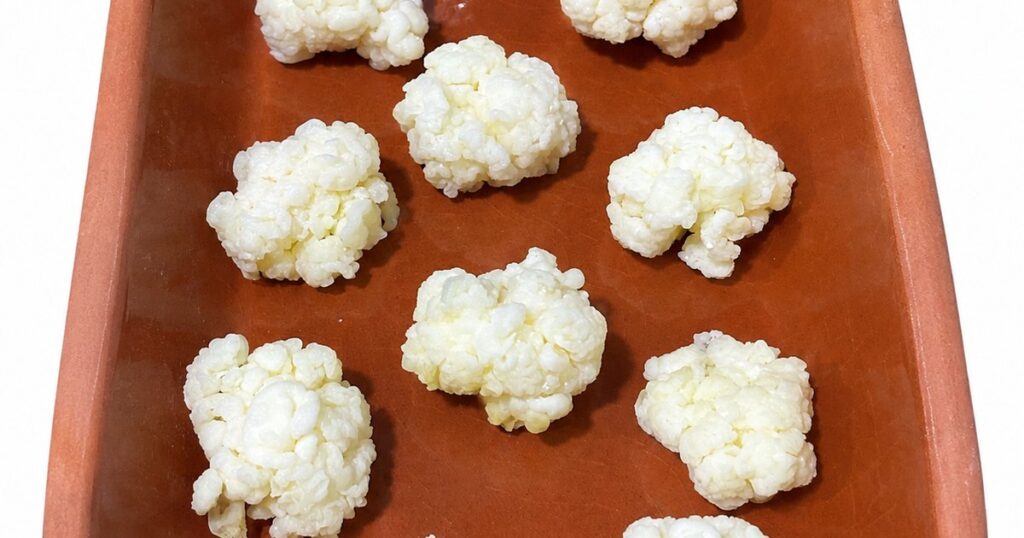
- Kefir grains are alive. They look like small cauliflower florets and hold many kinds of bacteria and yeasts living together.
- No two grains are the same. People have handed grains from one kitchen to the next for centuries, so every kitchen’s grains are a little different.
- Every batch shifts a little with the season, the milk and the temperature.
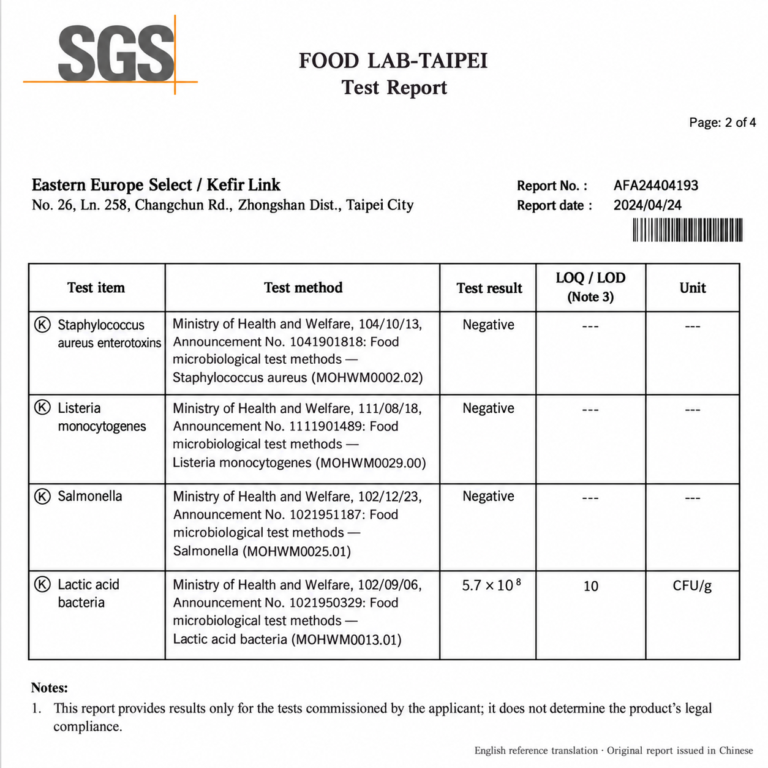
- So a strain test would describe one bottle only. We measure what holds for every bottle: in April 2024 SGS counted 57 billion live lactic acid bacteria in 100 g of our milk kefir, 57 times the national standard for fermented milk.
How we checked
- Research: reviews and studies of kefir grains, read in six languages. Each one is linked beside the sentence it supports and listed at the end.
- Our lab report: the SGS test of our milk kefir from April 2024.
What are kefir grains?
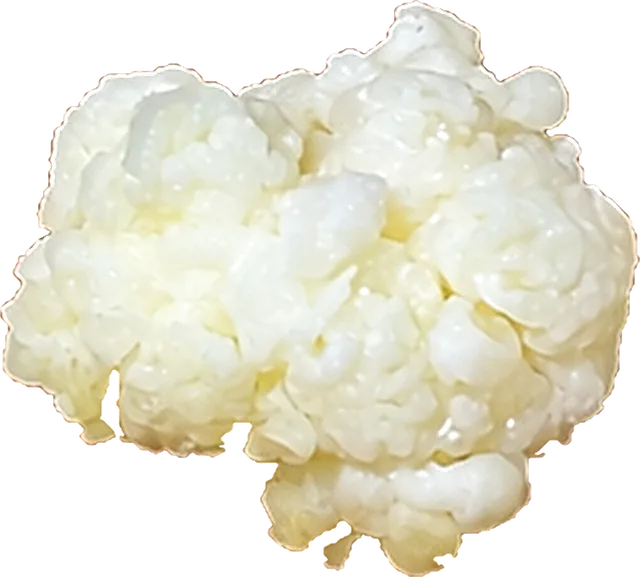
Try it: drag to turn the grain, tap it to look inside
This is a kefir grain. It is soft, springy and alive. The slippery coat is kefiran, a gel the bacteria make themselves.
Many people hear “grains” and picture a powder from a laboratory. Kefir grains are something you can see and hold: soft, white, springy lumps that look like small florets of cauliflower.
Inside, it is crowded. Lactic acid bacteria, yeasts and a few acetic acid bacteria live together and pass food to each other. This way of living together is called symbiosis (Prado and colleagues, 2015).
They all sit in a soft gel called kefiran, which the bacteria make themselves. Kefiran wraps the whole community and holds it together (BC Centre for Disease Control, 2024). It is the slippery coat you feel on a healthy grain.
Where did kefir grains come from?
Nobody invented kefir grains, and nobody knows exactly how the first one formed (Katchieva and colleagues, 2025). Kefir comes from the Caucasus mountains, where families fermented milk in bags made of sheep or goat skin (Bourrie and colleagues, 2016).
Two stories are told there. In one, soft white lumps were found in the folds of a skin bag in which milk had soured again and again. In the other, the lumps grew on pieces of calf stomach kept in goat’s milk. Science has not settled it.
Kefir is certainly old: the DNA of a kefir bacterium was found in cheese about 3,600 years old from a desert cemetery in Xinjiang (Liu and colleagues, 2024; see our article on that cheese). As far as published reviews report, laboratories have not yet rebuilt a traditional grain from separate cultures. In practice, new grains grow from old grains.
Why are grains different all around the world?
Because kefir grains are handed on, never manufactured. Each line of grains has its own history: where it came from, which milk it was fed and how warm its kitchen was.
When researchers compared 25 kefir grains from 8 countries, almost every grain had the same leading bacteria, and the smaller members differed from grain to grain (Marsh and colleagues, 2013). A larger study of 64 grains from 25 countries found the same: grains did not sort by country (Walsh and colleagues, 2023). They differ from kitchen to kitchen, not from country to country.
The mix keeps moving at home, too. Taiwanese milk is richer in winter than in summer (Food Next, in Chinese), so the same grains make a slightly different kefir in January and in July.
Which microbes lead at which temperature?
The same grains grow a different mix of microbes in a cool kitchen and in a hot one. Move the temperature and see what studies found, and which species can grow there at all.
What studies measured in kefir
At about 25 °C, round lactic acid bacteria lead
Round lactic acid bacteria, such as lactococci, outnumbered the rod-shaped ones about a thousand to one. Yeasts were plentiful, no acetic acid bacteria were found, and this kefir got the best taste score.
- Round lactic acid bacteriathe mostmeasured
- Rod-shaped lactic acid bacteriaa fewmeasured
- Yeastssomemeasured
- Acetic acid bacterianone foundmeasured
Which species can grow at this temperature?
From lab tests of each microbe on its own. In a grain they live together, so this shows who can be active, not who wins.
- Lactococcus lactis
- Lactococcus cremoris
- Leuconostoc mesenteroides
- Lactobacillus kefiranofaciens
- Lactobacillus kefiri
- Heat-loving lactic acid bacteria (only in some grains)
- Kluyveromyces marxianus
- Saccharomyces cerevisiae
- Kazachstania unispora
- Acetobacter
grows in lab testsunclear, or differs between strainsgrows best
Why is there no point in testing the strains?
A laboratory can read the genes in a sample and name the microbes it finds. This is called sequencing. It suits a product made from a few chosen strains, because every pack holds the same ones. With kefir grains it answers the wrong question.
- One test describes one bottle. The next batch has the same groups in slightly different shares.
- A strain code belongs to a culture that lives alone. A strain gets its name after a laboratory has separated it and grown it by itself; the guidelines also recommend storing it in a culture collection (FAO and WHO guidelines, 2002). In a kefir grain the microbes live mixed together.
- It would tell you nothing new about your bottle. What counts is how many live bacteria it holds and that it is safe. Those two things we measure.
So we tell you what stays true for every bottle, and we keep away from names we could not promise for the next batch.
Yogurt and kefir: where is the difference?
Yogurt starts with a packet of powder, kefir with living grains. The international food standard draws the same line: yogurt is defined by two named bacteria, kefir by a culture made from kefir grains (Codex standard for fermented milks).

Ordinary yogurt

Kefir
Starts with
What is inside
Each batch
On the pack
Afterwards


Species and strains are two different things
A species is a kind, like “mango”. A strain is one variety inside that kind, like Irwin and Jinhuang mangoes: both are mangoes, and they taste different.
A probiotic capsule is like a box of Irwin mangoes: a few chosen varieties, so each name and code can be printed. Kefir grains are like an old orchard with many kinds of fruit trees, where no two harvests are quite the same.
Which bacteria and yeasts do researchers find in kefir grains?
This list comes from published research on kefir grains from many countries. It is not a test of our own grains. We have not sequenced them.
How many kinds live in kefir? It depends on how you count.
- 7
kinds grown in the lab from grains collected in Taiwan: 4 bacteria and 3 yeasts
- 24–56
kinds of bacteria in one grain, told apart by their DNA
Marsh, 2013, counted by Bourrie, 2016
- 30–50
species of bacteria and yeasts living together in one kefir
- 50+
species found across all the grains studied so far
- 861
strains of 15 kinds of bacteria, in kefir made from 64 grains from 25 countries
in one grain or one kefiracross many grains
Lactic acid bacteria make kefir sour and set the milk
Lactobacillus kefiranofaciens also in Taiwanese grains
The main bacterium of the grain. It grows poorly on its own.
- Shape
- long rods
- Lives
- mostly in the grain
- Makes
- lactic acid and kefiran
- Taste
- linked to fruity notes
Lactobacillus kefiri also in Taiwanese grains
Helps hold the grain together as a sticky film.
- Shape
- rods
- Lives
- grain and milk
- Makes
- lactic acid, a little acetic acid, gas
Lactococcus lactis also in Taiwanese grains
Often the most common bacterium in the finished kefir, and one of the first to grow.
- Shape
- small balls in chains
- Lives
- mostly in the milk
- Makes
- lactic acid
Leuconostoc mesenteroides also in Taiwanese grains
Often becomes the most common bacterium late in the fermentation.
- Shape
- round cells
- Lives
- mostly in the milk
- Makes
- acid and gas
- Taste
- buttery
Found in some grains: Lactobacillus helveticus, Lacticaseibacillus paracasei, Lactiplantibacillus plantarum, Lactobacillus acidophilus, Streptococcus thermophilus.
Yeasts make the fizz
Kluyveromyces marxianus also in Taiwanese grains
The main yeast in the grains studied in Taiwan.
- Shape
- oval cells
- Milk sugar
- can use it
- Makes
- gas and a little alcohol
Saccharomyces cerevisiae
The same species as baker’s yeast. It lives on what the bacteria leave.
- Shape
- oval, budding cells
- Milk sugar
- cannot use it
- Makes
- gas and a little alcohol
- Taste
- fruity, yeasty
Kazachstania unispora
The most common yeast in grains from 8 countries.
- Shape
- oval cells
- Milk sugar
- cannot use it
Kazachstania turicensis also in Taiwanese grains
Thought to help new grains form, by clumping together with Lactobacillus kefiranofaciens.
- Shape
- oval cells
Found in some grains: Kazachstania exigua, Pichia fermentans.
Acetic acid bacteria add a light vinegar-like tang
Acetobacter
Common in grains, but missing from some.
- Shape
- short rods
- Makes
- acetic acid
- Taste
- vinegar-like
Found in some grains: Gluconobacter.
Bacteria people often ask about
- Lacticaseibacillus rhamnosus: found in kefir grains in one study
- Limosilactobacillus reuteri: one study
- Bifidobacteria: only traces of DNA, never grown from kefir
- Lactobacillus acidophilus, Streptococcus thermophilus, Lactobacillus bulgaricus: a few studies, in some grains
Sources: Bourrie, 2016, Prado, 2015, Georgalaki, 2021, Blasche, 2021, Walsh, 2016, Marsh, 2013, Codex and Wang, 2011.
What do we check?
The mix of microbes shifts a little from batch to batch. These are the things we measure.
- How many live bacteria. In April 2024 SGS counted 57 billion live lactic acid bacteria in 100 g of our milk kefir. The national standard for fermented milk, CNS 3058, asks for at least 10 million per millilitre. Ours is 57 times that.
- Safety. The same report tested for Salmonella, Listeria and the toxins of Staphylococcus aureus. All three were negative.
- Every day. Our kefir is made in a professional food factory in Taiwan under strict hygiene control, and the acidity (pH) of every batch is measured.
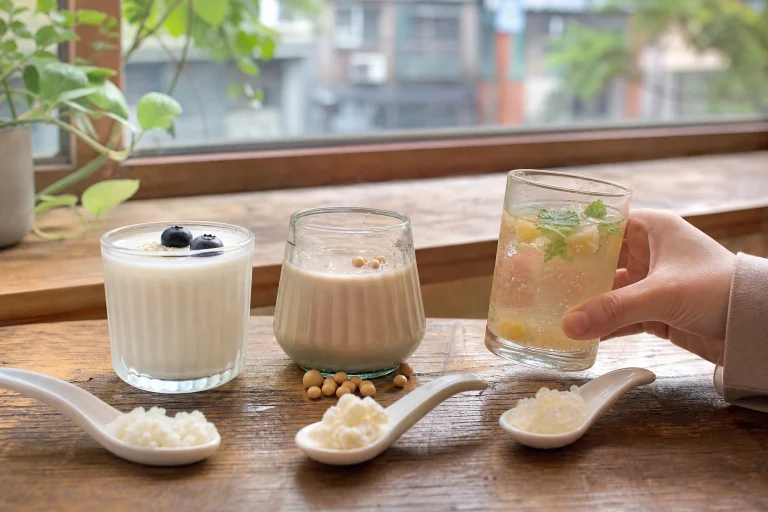
Take the living grains home.
Living kefir grains can ferment fresh milk in your own kitchen too, batch after batch. They come with a printed care guide.
Questions customers ask us
Which bacteria are in kefir?
Mostly lactic acid bacteria and yeasts, with a few acetic acid bacteria. They live together in the kefir grains. The species researchers have named are in What researchers find.
Why does the bottle have no strain list?
Kefir is fermented by a whole living community, and its mix shifts a little with every batch. Yogurt uses a few fixed bacteria, so they can be listed one by one.
Does it contain Lactobacillus rhamnosus or another particular strain?
Kefir grains have their own bacteria, led by Lactobacillus kefiranofaciens. Bacteria known from capsules, such as Lacticaseibacillus rhamnosus, have been reported in kefir grains in a single study (Bourrie and colleagues, 2016). If you are looking for one particular strain, choose a product that prints that strain on the pack.
With no strain list, how do I know there are live bacteria in it?
In April 2024 SGS counted 57 billion live lactic acid bacteria in 100 g of our milk kefir. The soft hiss when you open the bottle and the fine fizz in the glass also show that the yeasts are still at work.
Kefir is thinner than yogurt. Does it have fewer bacteria?
No. How thick it is depends on the milk and the way it is fermented, not on how many bacteria it holds. The count our lab measured is in What we check.
Are kefir grains a powder made in a lab?
No. Kefir grains are soft, white, springy lumps that look like small cauliflower florets. The bacteria and yeasts live inside kefiran, a gel they make themselves. The grains grow in milk, and once strained out they go into fresh milk for the next batch. In practice, new grains grow only from existing grains. More in What kefir grains are.
Does the mix change while the bottle is in the fridge?
Only slowly. Cold slows the bacteria and yeasts right down, so the mix changes very little. The longer the bottle is kept, the more sour and fizzy the kefir gets. How temperature shifts the mix is shown in Temperature and who leads.
Any question? Just message us on LINE. We’re always happy to help.
Message us on LINEResearch papers behind this article
Show all 21 papers
- Bourrie, Willing and Cotter, 2016, Frontiers in Microbiology
- Prado and colleagues, 2015, Frontiers in Microbiology
- Georgalaki and colleagues, 2021, Microorganisms
- Pogačić and colleagues, 2013, Mljekarstvo
- Marsh and colleagues, 2013, PLoS One
- Walsh and colleagues, 2023, iScience
- Blasche and colleagues, 2021, Nature Microbiology
- Walsh and colleagues, 2016, mSystems
- Magalhães and colleagues, 2011, Brazilian Journal of Microbiology
- Yerlikaya and colleagues, 2025, Food Science and Nutrition
- Ribeiro and colleagues, 2020, Foods
- Barukčić and colleagues, 2017, Mljekarstvo
- Grønnevik and colleagues, 2011, International Dairy Journal
- Leite and colleagues, 2013, Brazilian Journal of Microbiology
- Chen, Wang and Chen, 2008, Food Microbiology
- Wang, 2011, National Taiwan University thesis
- Katchieva and colleagues, 2025, World Journal of Experimental Medicine
- Liu and colleagues, 2024, Cell
- Codex Alimentarius, standard for fermented milks (CXS 243-2003)
- FAO and WHO, 2002, guidelines for the evaluation of probiotics in food
- BC Centre for Disease Control, 2024, fermented food guidance: kefir
Milk kefir, fermented with living grainsSee it



Comments
No comments yet.
Comments could not be loaded.
Join the discussion
or